
What is an MSP Provider? A Guide for Businesses
Businesses today face growing challenges managing complex technology environments. As IT systems become more critical and complicated, many companies turn to Managed Service Providers (MSPs) for help. MSPs offer proactive management and support that keeps technology running smoothly, allowing businesses to focus on their core goals without IT disruptions.

What Is an MSP Provider?
A Managed Service Provider, or MSP, is a company that remotely manages a business’s IT infrastructure and end-user systems. Instead of waiting for problems to occur, MSPs monitor systems continuously to prevent issues before they impact operations.
The MSP/client relationship is ongoing and collaborative. The MSP acts as an extension of the client’s team, handling routine IT tasks, troubleshooting, and strategic planning. This contrasts with traditional reactive IT support, where help arrives only after something breaks.
What Does an MSP Provider Do?
MSPs cover a wide range of IT responsibilities, including:
Monitoring and maintaining IT systems to detect and fix issues early
Providing ongoing technical support for users and devices
Managing networks and infrastructure to ensure reliable connectivity
Protecting systems and data through cybersecurity measures
Supporting cloud environments like Microsoft 365 or AWS
Helping plan future technology needs aligned with business goals
For example, an MSP might detect unusual network traffic and block a cyberattack before it causes damage, or they might upgrade software across all devices to improve security and performance.
MSP Provider vs. Break/Fix IT Support
Unlike break/fix IT support that responds only when something fails, MSPs offer proactive service. This means:
Ongoing relationship focused on prevention, not just repairs
Predictable IT management and costs through fixed monthly fees
Preventing problems before they disrupt operations by continuous monitoring
This approach reduces downtime and unexpected expenses, helping businesses maintain steady productivity.
What Services Should an MSP Provider Offer?
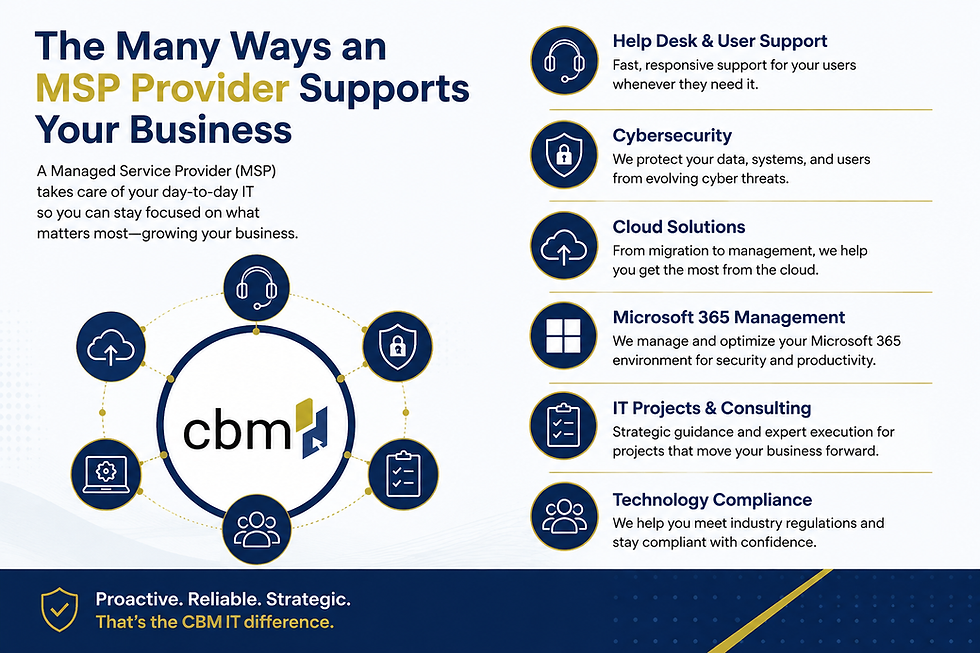
A comprehensive MSP should provide:
Managed IT and help desk support for daily technical issues
Cybersecurity services including threat detection and response
Cloud solutions to migrate, manage, and optimize cloud resources
Microsoft 365 management for email, collaboration, and security
IT projects and consulting for upgrades, migrations, and new tech
Technology compliance to meet industry regulations and standards
Choosing an MSP with these services ensures your business has a full IT support system.
Can an MSP Work With an Existing IT Team?
Yes, MSPs can complement your current IT staff in several ways:
Fully outsourced managed IT where the MSP handles all IT functions
Co-managed IT where the MSP and internal team share responsibilities
Filling skill and resource gaps by providing expertise your team lacks
Providing specialized expertise such as cybersecurity or cloud management
This flexibility helps businesses scale IT support without hiring full-time staff.
Benefits of Working With an MSP Provider
Partnering with an MSP offers many advantages:
Reduced downtime through proactive monitoring and fast issue resolution
Access to IT expertise without the cost of full-time specialists
Stronger cybersecurity with continuous threat detection and response
Predictable support and budgeting with fixed monthly fees
Improved scalability as your IT needs grow or change
Better long-term technology planning aligned with business goals
For example, a retail company working with an MSP avoided costly outages during peak sales seasons by having 24/7 network monitoring and quick incident response.
How to Choose the Right MSP Provider
When selecting an MSP, consider:
The range of services offered to cover your IT needs
Response times and availability to ensure timely support
Cybersecurity capabilities to protect your data and systems
Experience and expertise in your industry or technology stack
Communication and transparency for clear updates and reporting
The MSP’s ability to support future growth and evolving technology
Asking for client references and service level agreements (SLAs) can help evaluate potential providers.
Make IT a Strategic Part of Your Business
Understanding what is an MSP provider and how they operate reveals their value beyond simple IT support. A proactive MSP relationship transforms IT from a cost center into a strategic asset that supports business growth and resilience.
CBM IT offers managed IT services designed to be a long-term technology partner. Their team works closely with clients to reduce downtime, strengthen security, and plan for the future.
Contact CBM IT today to learn how partnering with an MSP can improve your business’s technology management and help you focus on what matters most.


Comments